| Decision | What the evidence supports | Planning use |
|---|---|---|
| Rice temperature | Thoroughly chilled cooked rice fries well. Warm or even lukewarm rice does not fry well in a hot pan. | Cook rice ahead. Leftover refrigerated rice is ideal. |
| Fresh rice in a hurry | Spread it on a pan, cover it, and chill for 30 minutes in the fridge or 10-15 minutes in the freezer (not frozen). | Treat the freezer as a short shortcut, and take the rice out before it freezes. |
| Pan readiness | Oil that shimmers or forms ripples across the surface means the pan and oil are hot enough. | Add food only after you see this cue. |
| Stove type | Gas and induction allow instantaneous heat changes. Electric stoves need additional time. | On electric, preheat early and adjust the heat sooner. |
| Wok material | Carbon steel responds well to quick heat changes. Stainless steel and cast iron take more time. | Choose carbon steel if you want the quickest control. |
These figures come from Gimme Some Oven’s fried rice guide and Made With Lau’s egg fried rice recipe.
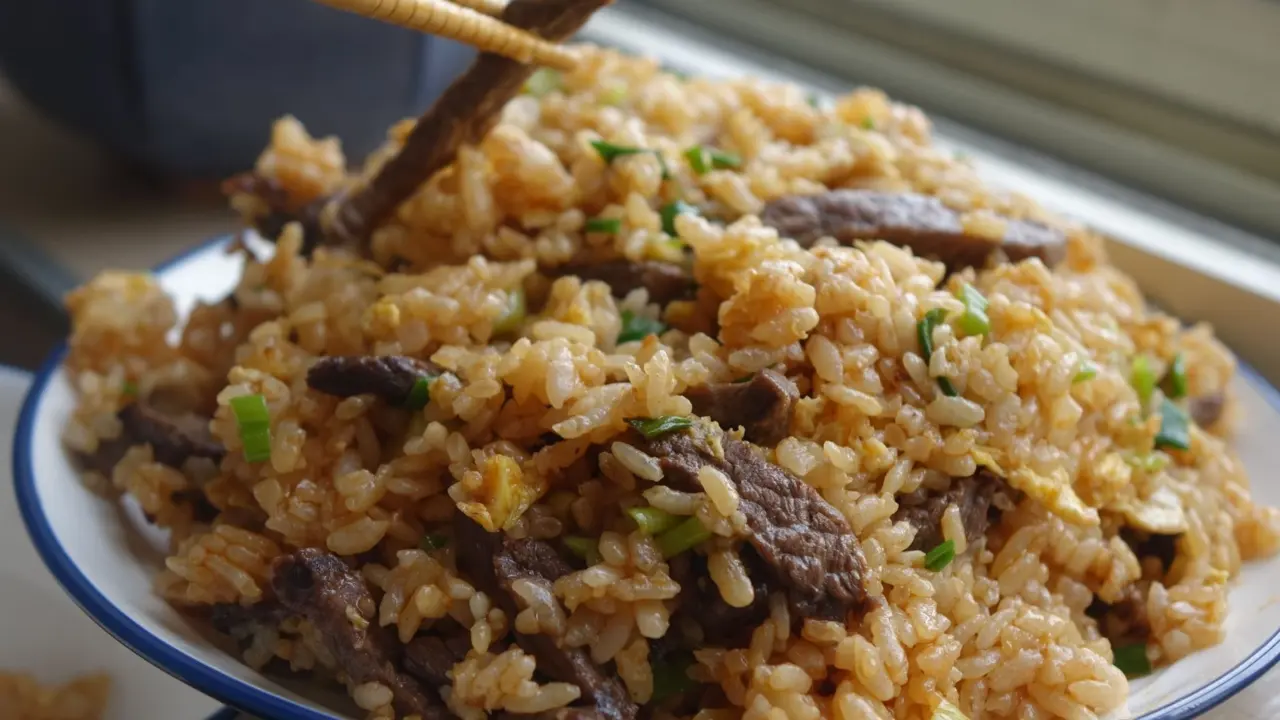
Chinese fried rice restaurant style comes down to thoroughly chilled rice, a very hot pan and small batches. On a home stove, those three choices matter more than any special ingredient.
If you are still building confidence at the stove, our guide to home cooking basics for beginners covers the general skills this dish leans on, such as prepping everything before the heat goes on.
What cold rice changes in the pan
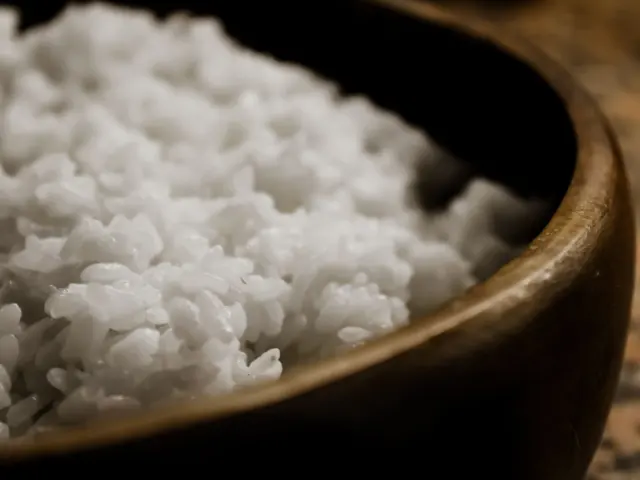
Cold rice stays in separate grains, while warm rice turns soggy and clumpy once it hits the pan. That is the answer to why fried rice calls for chilled rice, and it shapes every other decision on this page.
- Chilled rice fries instead of clumping. According to Gimme Some Oven, a fresh batch of warm or even lukewarm rice will not fry well when it hits the hot pan. The recipe asks for thoroughly chilled rice, and leftover refrigerated rice is ideal.
- Day-old rice trades aroma for texture. Made With Lau notes that day-old rice gives less clumpy, firmer fried rice than fresh rice, but it is also less aromatic. If you value fluffy separate grains, day-old rice is the right choice. The lost fragrance is something heat and finishing oil have to make up for.
- Fresh rice is not a dead end. If you cook rice the same day, chill it using the quick method in the table above rather than frying it warm.
Chilling is only half the job, because how you cook and store the rice decides whether it arrives in the wok dry or wet.
Rice prep, storage and quantities
Rice for fried rice is cooked slightly drier than usual, rinsed well, cooled, and kept loosely covered. The way you store it matters as much as the cooking.
Cooking and cooling the rice
Made With Lau says to rinse the rice 3-4 times until the water runs clear, which removes excess starch, and to use 5-10% less water than you normally would. For a batch that serves 4, its recipe uses 2 rice cups of uncooked jasmine rice with 1.9 rice cups of water.
For storage, Jason Farmer advises cooling the rice to room temperature and keeping it uncovered or loosely covered with parchment in the fridge for at least 12 hours. He warns never to seal it in a tight container while warm, because that traps steam and leaves the rice wet and clumpy. If you are cooking rice the night before, leave it uncovered at first and cover it loosely only once it has cooled.
Ingredient quantities
Two published home quantities give a useful range, depending on how much rice you have.
- Made With Lau, serves 4. Use 2 rice cups of uncooked jasmine rice, or 4-5 cups / 900g of leftover rice. This suits a family meal or a batch you plan to cook in parts.
- Andy Cooks, a smaller home batch. Andy Cooks uses 3 cups of cooked jasmine rice that has cooled completely in the fridge overnight, 2 eggs, 1 tbsp light soy, 1 tbsp dark soy, 1 tsp sugar, 1/2 tsp salt and 3 tbsp oil. This is the better starting point for a first attempt, as it is small enough to handle in one wok.
Scallions are also prepared ahead. Slice them thinly and keep the white and green parts separate, as Andy Cooks directs, because they go into the pan at different moments.
Wok hei on a home stove
Wok hei is the slightly smoky, caramelised flavour that restaurant fried rice gets from a very hot wok. Andy Cooks says fried rice needs a screaming hot wok to develop it, and one chef quoted by The Food Dictator says good fried rice must have that fragrance to draw you in.
A home burner will not match a restaurant range, and Jason Farmer is blunt that home burners cannot generate real wok hei. His practical answer is to heat the wok over medium-high until you see light wisps of smoke, then add toasted sesame oil once the heat is off. That gets you some of the smoky quality without pushing the equipment past what it can do.
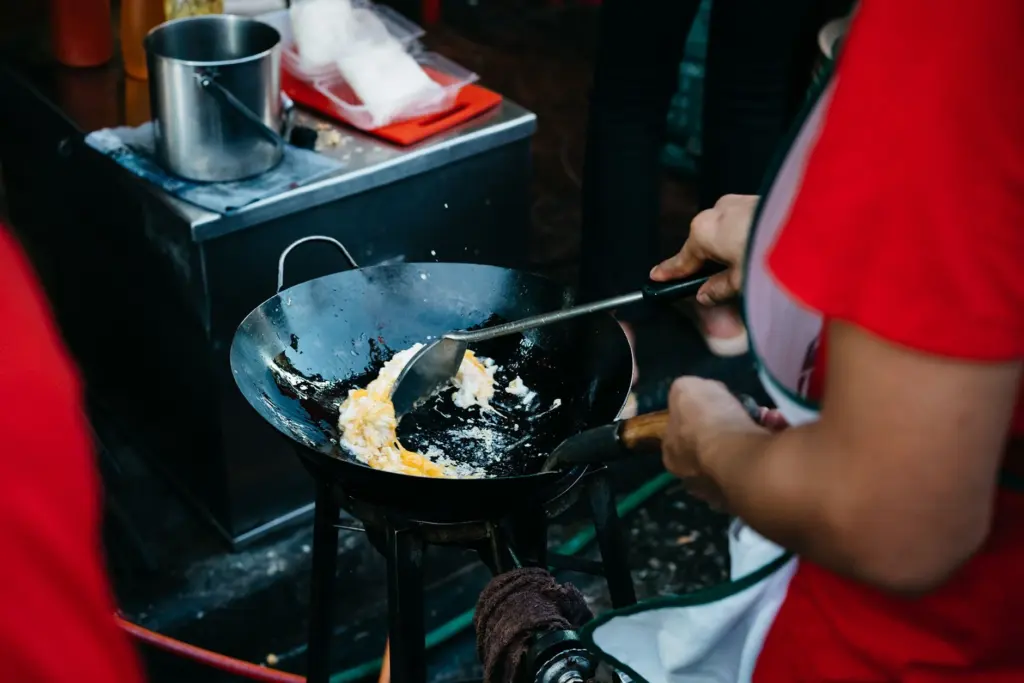
Technique when you cannot toss
Restaurant cooks flip the wok. At home, Andy Cooks suggests using a wooden spoon to keep everything moving instead of lifting the wok off the heat for long. Lifting the pan away from the burner costs you the heat you worked to build.
Choosing the pan
The material affects how much control you have. Carbon steel suits this dish because it responds well to quick heat changes, while stainless steel and cast iron take more time to adjust. If you already own a heavier pan, preheat it for longer and make fewer changes to the flame once food goes in. Gas and induction cooktops let you change the heat at once. On an electric stove, you need to plan the heat changes ahead.
Soy sauce and seasoning
Restaurant-style flavour comes mainly from soy sauce, used with a light touch and added in a specific way. The quantities above use both light and dark soy, with a little sugar and salt, which is a simple base to start from.
The soy goes around the wok, not onto the rice. Jason Farmer says to pour the sauce mixture around the rim of the wok so it caramelises before touching the rice. Andy Cooks gives the same direction, pouring around the edge rather than in the centre so the sauce distributes evenly. Either way, you avoid a wet patch of sauce in the middle of the rice.
On brands, Farmer states that Lee Kum Kee or Pearl River Bridge are what Chinese takeout restaurants actually use. That is one author’s claim rather than a rule, but both are easy starting points if you want to match takeout flavour. Whichever you choose, taste before adding extra salt.
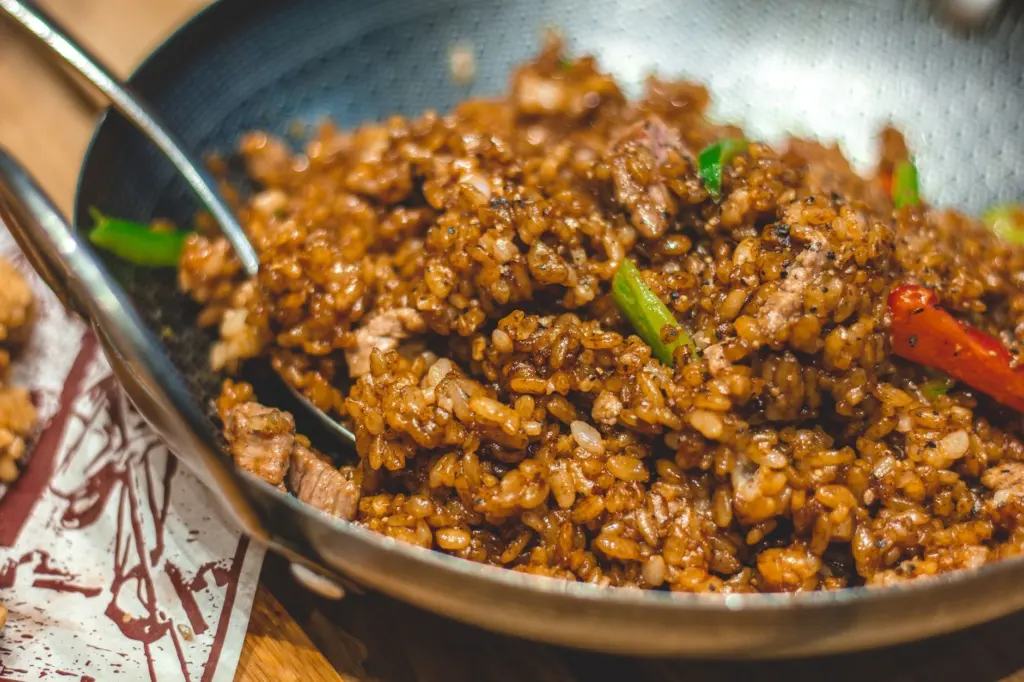
Order of cooking and timing
Fried rice is a fast dish once the prep is done. Andy Cooks lists a prep time of 20 minutes and a cook time of 10 minutes, and Made With Lau lists 5 minutes of prep and 13 minutes of cooking, 18 minutes in total for 4 servings. The difference comes mostly from how much you prepare in advance.
- Prepare the rice and slice the scallions, keeping whites and greens apart.
- Heat the wok until the oil shimmers or forms ripples, the cue given by Made With Lau.
- Cook the eggs and remove them at about 80% cooked. They finish when added back at the end.
- Fry the chilled rice in a small batch so it fries rather than steams.
- Pour the soy mixture around the rim of the wok.
- Return the eggs and add the scallion greens in the final toss, keeping some for garnish.
- Take the wok off the heat and add toasted sesame oil.
Pulling the eggs early prevents them turning rubbery and dry while the rice cooks. Holding the scallion greens back keeps their colour and fresh bite.
Pairing with other restaurant-style recipes
Fried rice works well as part of a restaurant-style spread at home. If you are cooking for a crowd, the Restaurant-Style Queso: How To Make Creamy, Crowd-Pleasing Dip At Home (2026 Copycat Guide) – Bionicbites gives you a dip to serve alongside. For a breakfast version of the same crisp-edged approach, see Diner-Style Home Fries: Crispy, Seasoned Potatoes For Breakfast At Home – Bionicbites.
Frequently asked questions
Can I make a larger batch in one pan?
It is better not to. Jason Farmer recommends small batches on a regular stovetop so each component gets properly fried instead of steamed. Cook in rounds and combine.
Should the rice go in straight from the fridge?
Advice varies. One chef quoted by The Food Dictator says never to fry rice straight from the fridge and suggests warming it briefly in the microwave until barely warm. Andy Cooks uses rice completely cooled overnight in the fridge. In both cases the rice is chilled and dry, not freshly cooked.
Why does my fried rice taste too salty?
Soy sauce brands vary. Gimme Some Oven points out that different brands contain dramatically different levels of sodium, so taste the rice and adjust the added salt to suit the soy sauce you use.