First-timers deciding what to order at Indian restaurant menus should pair a mild creamy main with a vegetable dish, share a starter, and add garlic naan and rice, then state a heat level: mild, medium or hot.
The plan below sorts dishes by spice, protein and cooking style. For choosing the venue itself, see our guide on how to choose a good restaurant.
How an Indian menu is organised
Most Indian menus run in a fixed order, which makes the choice easier. Flavor of India describes a starters section of fried and tandoori snacks, then a big block of mains. Mains are usually split by protein, followed by breads and rice, then sides, drinks and desserts. That gives five or six categories to choose from, and you only need one or two items from each.
Three questions narrow the field quickly:
- How much heat do you want? Creamy sauces sit at the mild end, while dishes built around chilli and tang sit at the other.
- Which protein? Chicken, lamb, goat, paneer (fresh cheese), lentils and egg all appear, often in the same sauce style.
- Which cooking style? Tandoor dishes come from a clay oven, while gravies are simmered. Mixing one of each gives variety on the table.
Spice levels: what the heat labels mean
Spice is the easiest variable to control. Restaurants will adjust a dish if you tell your server your heat level: mild, medium, or hot. Calibrate your expectations first: at Spice Room in Denver, “medium” has noticeable heat, and “hot” is for experienced spice lovers. If you are unsure, ask for mild or medium rather than hot.
Creamy, yogurt- or tomato-cream-based gravies are the mild group. The table groups the dishes most often recommended to newcomers.
| Dish | Heat and style | Dietary note | Planning use |
|---|---|---|---|
| Butter chicken | Mild and creamy; faintly sweet, never spicy | Chicken | The safest first main, and a good anchor for a shared table. |
| Chicken tikka masala | Mild to medium; butter chicken’s tangier cousin | Chicken | Choose it when you want a little more tang than butter chicken. |
| Korma | Mild and nutty, creamy and yogurt-based; among the mildest dishes on any menu | Offered with different proteins | Best for heat-averse diners or children. |
| Vindaloo | Real heat with a sharp, tangy punch | Meat dish | Order only when the whole table wants heat. |
| Saag paneer | Spiced spinach gravy; sold as palak paneer on some menus | Vegetarian (fresh cheese) | A green, non-creamy contrast to the red gravies. |
| Hyderabadi dum biryani | Often one of the spicier biryani varieties | Usually chicken | Ask about heat before ordering it for a mixed-tolerance group. |
Descriptions come from Flavor of India’s ordering guide, with the biryani and palak paneer notes from Sukhi’s Indian food guide.
If a dish is hotter than you expected, reach for dairy. Flavor of India notes that dairy, not water, is the real defence against chilli heat, which is why lassi and raita are worth ordering. Musafir Kitchen gives the same practical advice: ask your server to make a dish mild or medium and keep a lassi or raita on the table.
Starters to share
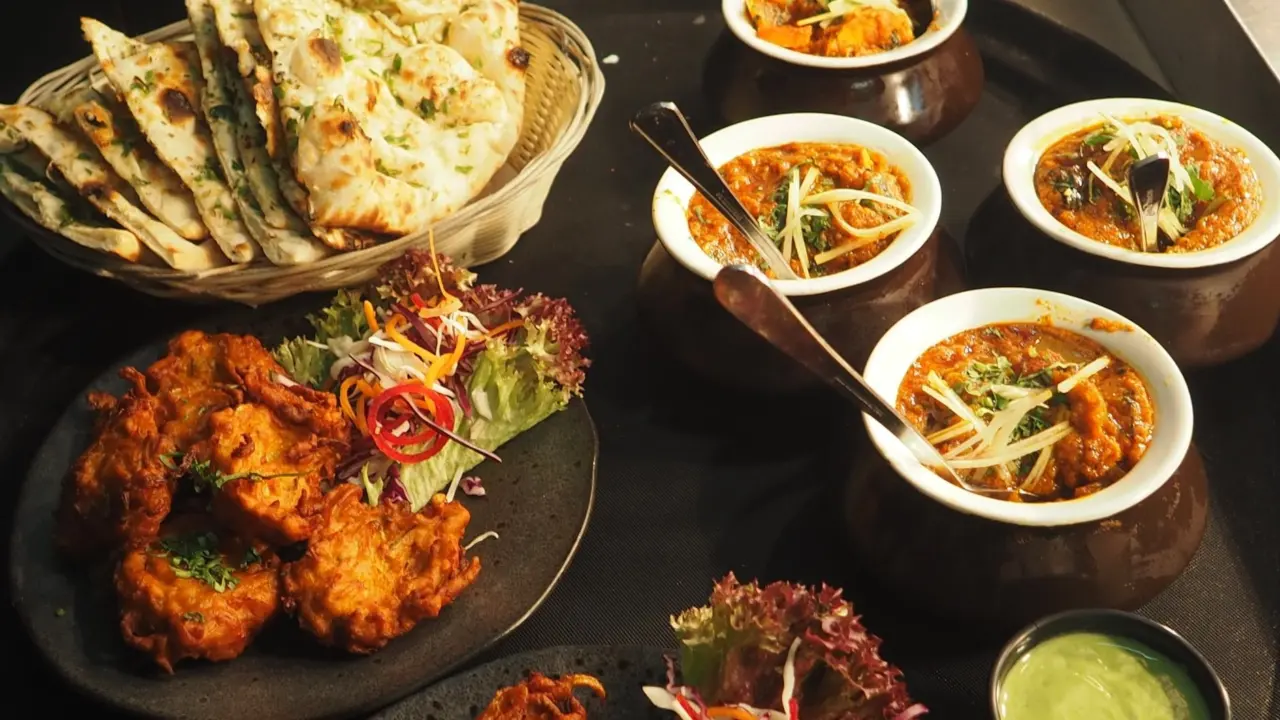
A single shared starter is enough to open the meal, and the samosa is the standard pick. It is a crisp pastry triangle stuffed with spiced potatoes and peas. Clove Garden lists a veg samosa filled with seasoned potatoes and peas, but fillings vary by kitchen. Sukhi’s notes that samosas can contain a small amount of spicy potato or meat filling. Vegetarians should therefore check the menu label or ask before ordering.
Pakoras are the other commonly suggested sharing starter, and a tandoori starter adds a clay-oven dish before the gravies arrive. Musafir Kitchen’s group formula includes a tandoori starter alongside the curries. If you take a fried starter and a tandoori one, skip a second fried item among the mains so the meal does not feel heavy.
Mains by protein and cooking style
Pick the main by protein first, then by sauce style. Each of these suits a different kind of diner.
Chicken: butter chicken or tikka masala
Musafir Kitchen calls butter chicken creamy, mild and beloved for a reason. Chicken tikka masala is built on the same logic: Clove Garden describes grilled chicken cooked in a creamy tomato-based sauce. Choose butter chicken if you want zero heat, and tikka masala if you want a tangier sauce with a little more edge.
Vegetarian: saag paneer and dal makhani
Saag paneer is soft cubes of fresh cheese in a lush, spiced spinach gravy. It also appears as palak paneer. Dal makhani is black lentils slow-cooked with butter and cream until velvety, so it is rich rather than hot. Between them they give a vegetarian table both a green gravy and a creamy lentil dish. If your group eats meat, one vegetable main still balances the heavier cream sauces. Clove Garden also offers chicken saag, so the spinach style works for meat eaters as well.
Biryani: the one-dish option
Biryani suits anyone who wants a single order. Clove Garden notes that it is often considered a complete meal because it combines rice, spices and protein in one dish. The same menu offers goat, lamb, veg, paneer and egg versions. If you order biryani as your main, you can skip separate rice and rely on a raita for the cooling side.
Breads, rice and drinks
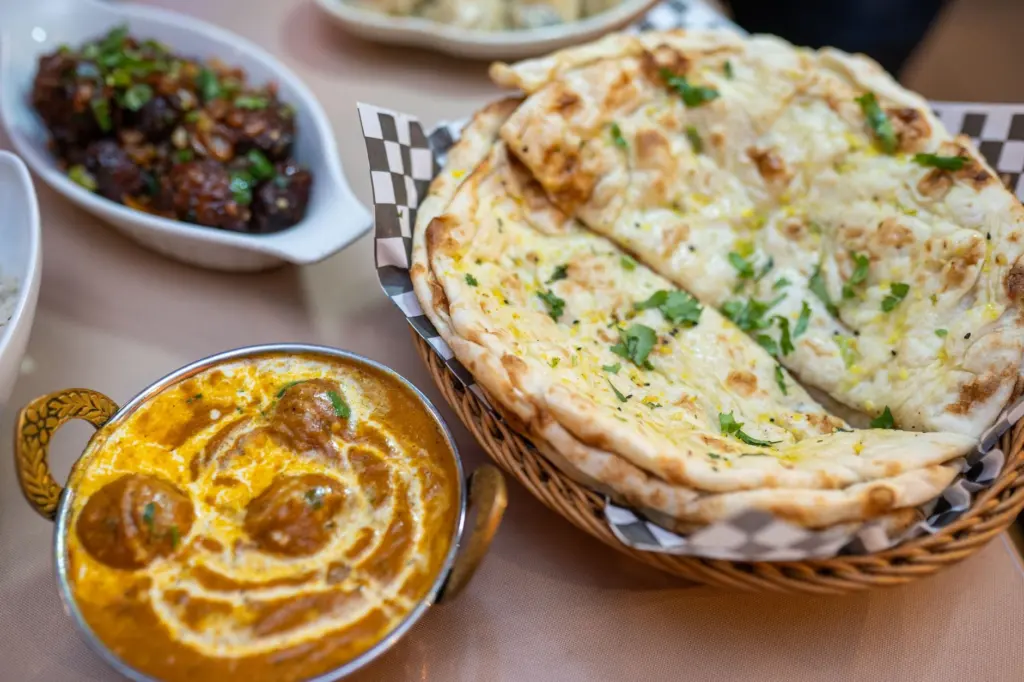
Bread is functional here. Musafir Kitchen calls garlic naan soft, warm flatbread that is essential for scooping up gravy. Clove Garden describes it as soft and fluffy bread baked in a clay oven with garlic and butter.
The clay oven explains the texture. A tandoor is a cylindrical clay oven that reaches 900°F (about 480°C). At that heat, garlic naan bakes in about a minute. For that reason naan arrives fresh and fast, and it is better ordered with the mains than long before them.
Plain steamed rice suits saucy dishes. Skip it if you have a biryani. For drinks, mango lassi is the sweet, dairy-based choice that also tames chilli heat.
Building the order step by step
Portion size shapes the order more than appetite does. Flavor of India says that Indian portions are generous and built for sharing, so you rarely need one main per person. Order in this sequence, then add more only if the table is still hungry.
- Set the heat. Tell the server mild, medium or hot before you order anything.
- Choose one starter to share. Samosas or pakoras are the easy options.
- Pick a creamy main. Butter chicken or korma gives a safe base.
- Add a contrast. Take a vegetable or lentil main, such as saag paneer, that differs in colour and texture.
- Finish with bread, rice and a drink. Garlic naan, rice and a lassi complete the table.
Sample meal for two
Flavor of India suggests one starter to share (samosas or pakoras), one creamy main (butter chicken or korma), one vegetable main, garlic naan, rice and a mango lassi. That covers fried and gravy textures, one meat dish and one vegetable dish, and a cooling drink.
Scaling up for a group
For a bigger table, Musafir Kitchen’s formula is one mild curry, one bolder one, a vegetarian dish, a tandoori starter, rice and breads. Add a second mild dish rather than a second hot one if anyone is unsure about heat, since mild dishes can be shared by everyone and hot ones cannot.
Dietary labels and vegetarian choices
Vegetarian diners are well served. Flavor of India points out that Indian cuisine has one of the richest vegetarian traditions in the world. Saag paneer, dal makhani and veg samosas are the standard picks, and biryani comes in vegetable and paneer versions.
Check three details before ordering. First, samosa fillings can include meat. Second, paneer and lentil dishes may be finished with butter or cream, so they are vegetarian but not dairy-free. Third, egg biryani appears on some menus, so confirm whether egg is acceptable to your table. Menu labels differ between restaurants, so ask when a dish matters for dietary reasons.
Choosing where to eat
The same plan works at most Indian restaurants, but the venue affects how adventurous you can be. If you are weighing an upscale dining room against a casual spot, What Is A Michelin Star Restaurant? The Insider Guide To What The Stars Really Mean (2026) – Bionicbites explains what a star rating does and does not tell you. For another cuisine where ordering and eating habits matter, How To Eat Pho Like A Pro: Slurps, Toppings, And Etiquette For 2026 – Bionicbites covers the basics.
Frequently asked questions
What should a first-timer order?
Start with butter chicken, a vegetable dish such as saag paneer, garlic naan and rice, plus a shared samosa. Biryani is the alternative if you prefer a single complete dish.
How spicy are the dishes?
Butter chicken and korma are mild, tikka masala runs mild to medium, and vindaloo brings real heat. Most kitchens will adjust to mild, medium or hot on request.
How much should I order for a group?
Fewer mains than people. Portions are built for sharing, so a mild curry, a bolder curry, a vegetarian dish, a starter, rice and breads works as a base formula.
What are the vegetarian options?
Saag paneer (also called palak paneer), dal makhani, veg samosas and veg or paneer biryani are all vegetarian. Ask about meat-filled samosas and dairy if either matters.